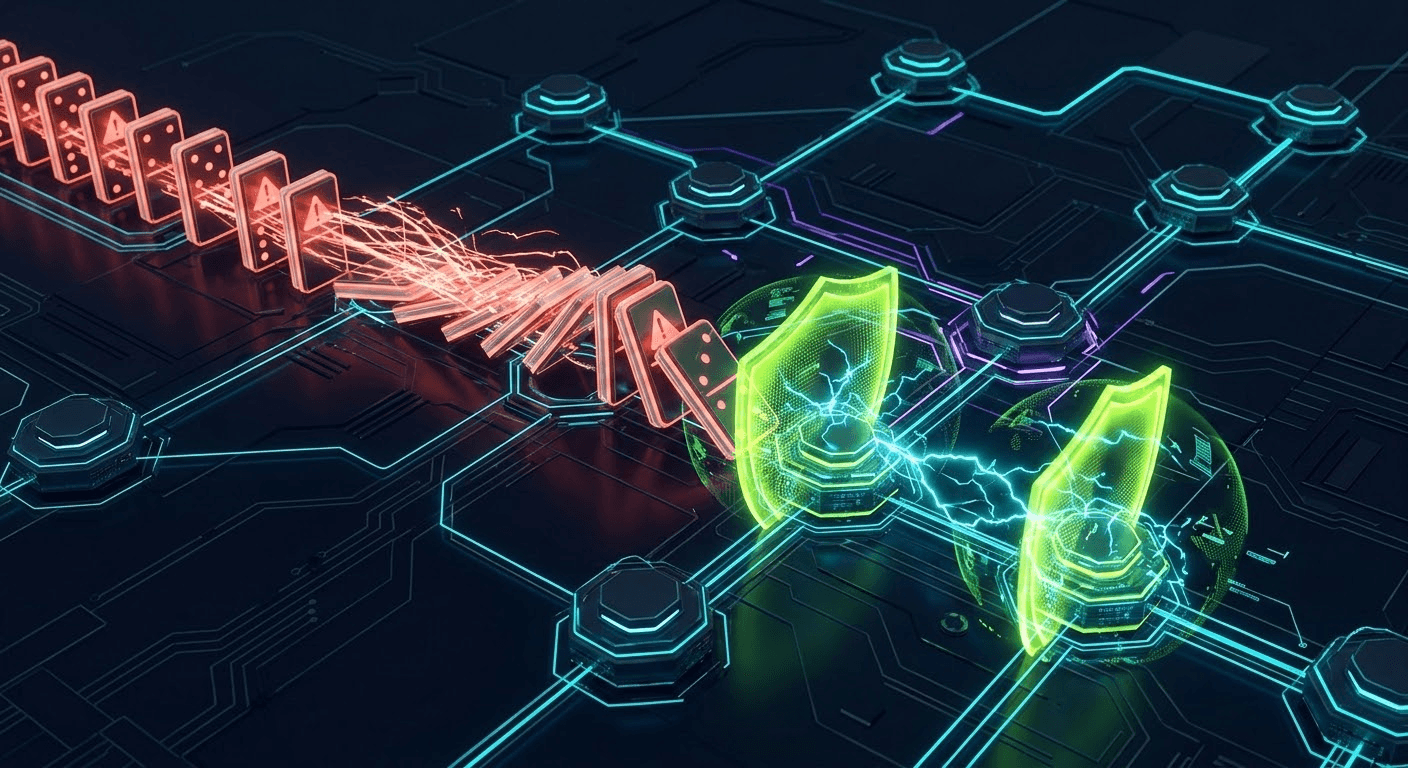

The numbers are stark. According to data aggregated from public status pages and incident tracking platforms, SaaS services experienced 156 major incidents in the past 12 months — a 69% increase from the prior year. Cumulative degraded service time hit 9,255 hours across tracked platforms. For SaaS operators and their customers, this isn't a blip — it's a structural trend.
THE DATA TELLS A CLEAR STORY
Breaking down the incidents reveals three dominant patterns:
Pattern 1: Cascading Infrastructure Failures (41% of incidents)
The most common cause isn't a single component failing — it's failures that cascade through interconnected systems. A database connection pool exhaustion causes API timeouts, which triggers aggressive retries from clients, which overwhelms the load balancer, which drops healthy connections too. What started as a small database issue becomes a full outage in minutes.
Pattern 2: Configuration and Deployment Errors (28% of incidents)
Nearly a third of major incidents were caused by human error during deployments or configuration changes. Mistyped environment variables, untested database migrations, feature flags that interacted unexpectedly, and rollback procedures that didn't work when needed. The irony: these incidents happen because teams are shipping fast.
Pattern 3: Third-Party Dependency Failures (22% of incidents)
Your SaaS product is only as reliable as its least reliable dependency. Payment processors, email services, CDNs, authentication providers — when any of these go down, your product goes down too, even if your own infrastructure is perfectly healthy.
THE REAL COST OF DOWNTIME
For SaaS operators, downtime isn't just an engineering problem — it's a business problem:
- Revenue loss — Average SaaS company loses $5,600/minute during full outage
- SLA penalties — Enterprise contracts with 99.9% uptime SLAs mean financial penalties after just 8.7 hours/year of downtime
- Customer trust erosion — Each incident increases churn probability by 2-5% for affected customers
- Engineering productivity — Post-incident reviews, customer communications, and firefighting consume team capacity that should go toward features
PROTECTION STRATEGIES THAT ACTUALLY WORK
1. Circuit Breakers on Every External Dependency
The circuit breaker pattern prevents cascading failures by failing fast when a dependency is unhealthy. Every external API call — payment processing, email, third-party auth — should be wrapped in a circuit breaker:
// Circuit breaker pattern for external dependencies
const breaker = new CircuitBreaker(paymentService.charge, {
  timeout: 5000,        // Fail if call takes > 5s
  errorThreshold: 50,   // Open circuit at 50% error rate
  resetTimeout: 30000,  // Try again after 30s
  volumeThreshold: 10,  // Need 10 calls before calculating error rate
});

// Falls back gracefully instead of hanging
const result = await breaker.fire(chargeRequest)
  .catch(() => queueForRetry(chargeRequest));
2. Progressive Deployment with Automatic Rollback
The 28% of incidents caused by deployments are almost entirely preventable. The key is progressive rollout with health checks:
- Canary deployments — Route 5% of traffic to the new version, monitor error rates for 10 minutes
- Automatic rollback triggers — If error rate exceeds baseline by 2x, roll back automatically without human intervention
- Feature flags as kill switches — New features behind flags that can be disabled in seconds, without a deployment
- Database migration safety — Never deploy destructive migrations (DROP COLUMN) in the same release as application changes
3. Multi-Provider Redundancy for Critical Paths
If your payment processing runs through a single provider, a Stripe outage is your outage. Critical paths need redundancy:
- Dual payment processors — Primary + fallback with automatic failover
- Multi-CDN — DNS-based failover between CDN providers
- Email fallback — If SendGrid is down, route through SES automatically
- Auth independence — Don't make login dependent on a third-party OAuth provider being available. Always offer email/password as a fallback
4. Incident Response Automation
The difference between a 5-minute incident and a 5-hour incident is often response speed. Automate the first response:
- Automatic status page updates — When monitors detect an issue, update the status page immediately — don't wait for a human to confirm
- Pre-written customer communications — Template incident notifications that can be sent in seconds
- Runbook automation — Common remediation steps (restart services, scale up, flush caches) triggered automatically by specific alert patterns
- War room creation — Automatically create a Slack channel, page the on-call team, and pin relevant dashboards
BUILDING A DOWNTIME-RESISTANT SaaS
Zero downtime is impossible. But the gap between 99.9% (8.7 hours/year of downtime) and 99.99% (52 minutes/year) is achievable with the strategies above. The key insight from studying 156 incidents: most outages aren't caused by unpredictable failures — they're caused by predictable failures that weren't planned for.
Every SaaS operator should be asking: do we have circuit breakers on our external dependencies? Would a bad deployment automatically roll back? If our primary payment processor goes down, do we have a fallback? If the answers are "no," the 156-incident statistic includes a future incident of yours.


